
Sunday, October 3, 2021
Transitioning this blog
I will be posting mostly from my own website in the future because of better control and better looking images, so update your links and bookmarks (I know I am oldfashioned). Future posts can be found here: https://lagemaatphoto.smugmug.com/Blog

Sunday, May 12, 2019
Nature First - an excellent new initiative
Most of you will by now have seen some mention of Nature First. As soon as I heard about this initiative I signed up for it. The initiative codifies a set of principles that are designed to protect natural places across the world. In my travels throughout the American West and beautiful places in the rest of the world I come across a lot of evidence of careless use and entitled behavior that slowly destroys places. We have also all seen the result of popularization of places through instagram and other such social web services. The famous bend in the river at Horseshoe Bend for example is now completely overrun. Places in Yosemite now have a line of people waiting for their turn to take that perfect selfie. Go to Maroon lake to photograph the Maroon Bells at sunrise and there will be over 100 tripods lined up. Some of these places have even had folks fall to their deaths in the search of the perfect selfie. This is a very hard thing for me to think about. On the one hand I want more and a more diverse set of people to enjoy these places but they also need protection. This is why I like that the Nature First initiative codifies both a "think before you share" approach and an approach of educating others.
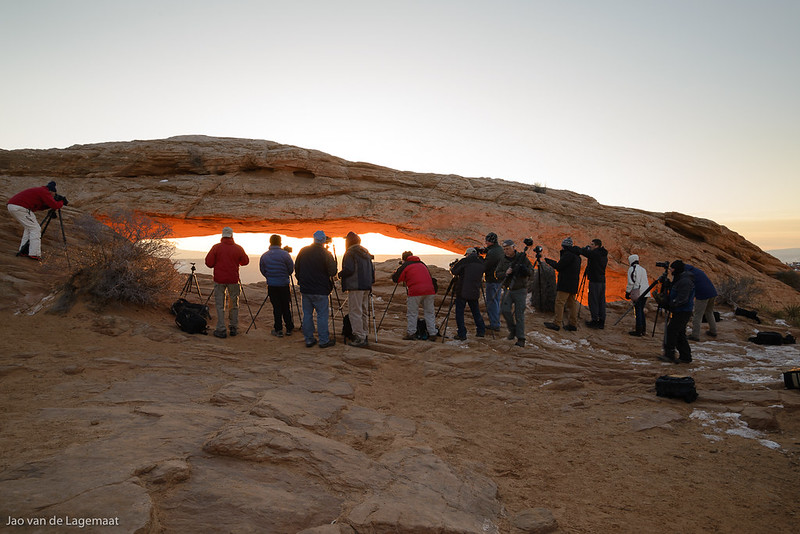
Mesa Arch at a time when you could still find a spot. This has now become impossible
Think before you share refers to both GPS coordinates and if a place is specifically fragile, perhaps not sharing online at all. A now famous place in Canyonlands for example - False Kiva, has now become discovered and the way to get to it has become a virtual highway. The last time I was there it shockingly had several cigarette butts in the middle of it. I also found fresh charcoal spread around. The handprints are now almost invisible. This increased visitation would not be an issue if people would respect the place but alas that is not a shared expectation.

False Kiva used to be a fairly unknown place and is now common knowledge. Shockingly, people leave trash in it
All of this is why I signed onto Nature First and I encourage you all to do the same.
I'll reflect a bit on each:
Mesa Arch at a time when you could still find a spot. This has now become impossible
Think before you share refers to both GPS coordinates and if a place is specifically fragile, perhaps not sharing online at all. A now famous place in Canyonlands for example - False Kiva, has now become discovered and the way to get to it has become a virtual highway. The last time I was there it shockingly had several cigarette butts in the middle of it. I also found fresh charcoal spread around. The handprints are now almost invisible. This increased visitation would not be an issue if people would respect the place but alas that is not a shared expectation.
False Kiva used to be a fairly unknown place and is now common knowledge. Shockingly, people leave trash in it
All of this is why I signed onto Nature First and I encourage you all to do the same.
The 7 principles are:
- Prioritize the well-being of nature over photography.
- Educate yourself about the places you photograph.
- Reflect on the possible impact of your actions.
- Use discretion if sharing locations.
- Know and follow rules and regulations.
- Always follow Leave No Trace principles and strive to leave places better than you found them.
- Actively promote and educate others about these principles.
I'll reflect a bit on each:
Prioritize the well-being of nature over photography. This should be obvious but what it means in practice is that your photograph is not worth trampling the fragile biotic crust, crossing a boundary put there for safety or to protect fragile natural or cultural resources. I was shocked when I got to the Moon House at Cedar Mesa, a beautiful site protected by a permit system, to find that the very sensitive moon room had been entered by many people judging by all the footprints contrary to the warnings by the rangers at the place where you have to get your permit and the signs left there to not do this. As a consequence, the moon phases drawn inside the moon room are no longer really visible!

The Moon House in Cedar Mesa houses several intact rooms. You can enter the gallery but not the individual rooms which have very fragile drawings.
Educate yourself about the places you photograph. Make sure you know about the particular sensitivities of a place you visit for photography. Does it have sensitive plants? Is there a danger of erosion? Are there any particular dangers to you inherent to the place? I always research a place extensively before I visit it and this is both to understand how to have minimal impact and how to protect myself and others.

Turret Arch as seen from one of the windows. This is a top photography location in Arches National Park. At sunrise there will be a long line of photographers waiting for their turn to get the shot from the perch. Arches also has very sensitive biotic crusts that are destroyed by even a single person walking over them. Be aware!
Reflect on the possible impact of your actions. This is of course a corollary to the previous principle but it goes beyond it. Think for example about what happens when you cross a boundary at a popular site to get a slightly better vantage point? It is highly likely that a stream of others will follow you. While your own action might have been not enormous impact, 10's of people following you might be another question!
Use discretion if sharing locations. Note that this does NOT say to not share locations. It really means that you should think before you share GPS locations or precise directions. Will this place perhaps become the next instagram sensation? If so should you really enable that? Instagram sensations have a few defining characteristics. One is that it has to be trivially reachable. Most instagrammers will not walk for more than 15 minutes to get to a point so if your location is hard to reach it is probably relatively safe but still think hard about it. Second it has to be super photogenic and lend itself well to selfies. If the image is only obtainable using specialized lenses and you can't really do selfies there that will work well on instagram, probably not much of an issue. Still think deeply about this!
Know and follow rules and regulations. Please do! The many footprints inside the moon room are testament to folks ignoring the rules and really causing a combined impact. Many of us have seen the scarred tracks in the moss at the gorgeous iceland waterfalls past the forbidden signs. Not OK.
Please follow the rules. The consequences could be severe. Kirkjufell is one of those places where many ignore the ropes and signs
Always follow Leave No Trace principles and strive to leave places better than you found them. Leave no trace is a very useful set of rules to live by when in nature. Pack out what you brought in. It is way too often I come across litter like granola bar wrappers, soda cans, and yes, cigarette butts. Just carry a waste bag in your backpack and carry it out. If you are in a place that requires you to carry out your own bodily waste, do so. It is not that hard to do.
Actively promote and educate others about these principles. What I am doing here. I have always and will continue to make sure people know how to enjoy the wilderness and nature without harming it. Please do so too. Promote the 7 principles and encourage others to become members of the alliance. Promote responsible outdoor citizenship!
Saturday, February 23, 2019
Enhanced details and what kind of images it helps with

The Heavens open
Adobe has added a cool new geeky feature in the latest release of Lightroom and ACR. These are Classic 8.2, CC 2.2, and ACR 11.2. The feature uses machine learning to analyze and learn from your raw file to eke out the last very bit of detail. For some cameras that have non-Bayer mosaic sensors such as Fuji's X-trans sensors, this is enormously impactful and improves almost every image. However for regular Bayer sensors, you will rarely see any improvement. I estimate that perhaps 1% of my images show any improvement and then you will only see it in humongous prints. The problems manifest in artifacts visible in the standard demosaic and are solved by the enhanced detail feature. For the fall color image below that shows definite improvement when looked at at 1:1, I have a 4 feet high print in my office where you will have a hard time seeing it. So this feature is really for the most extreme pixelpeepers out there. Nevertheless since I am a geek and appreciate the imaging science behind this, I thought I'd show you a few instances where you can expect improvement. These all have to do with the very specific characteristics of Bayer array sensors. A Bayer array sensor as is common in almost every DSLR and also cellphones and compact cameras, has its pixels laid in a way that you have twice as many green sensitive pixels as blue or red. It looks like the below where every square is a single pixel on the sensor and the color indicates different color filters in front of the pixel:

The job of a raw converter is to try and intelligently interpolate between the different pixels to generate a full color image. The existing algorithms for this are not always very smart and even Nikon's own raw converter can generate artifacts under certain circumstances. However Adobe has done something extraordinary and uses artificial intelligence to get around this problem. Also, the above figure immediately tells you that detail that only has blue or red will be prone to artifacts. This is precisely where you might find improvement from this feature. Below is a zoomed in view of an image I found in my library that had these exact issues. These are images from a Nikon D600 which is a 24 MP camera. Remember that yellow is really green and red combined. You should click or tap it to see it bigger:

You can clearly see that in the regular image as well as the image converted using Nikon's own software there are very ugly artifacts around the leaves. The enhanced detail algorithm is able to get around the problems caused by the Bayer mosaic sensor lack of detail in blue and red. To make it more obvious here is the two even more zoomed-in views:
Standard Demosaic

Enhanced Details:

Enhanced Details:
Note that at the scale you are watching this, if you are on a typical desktop computer, it would correspond to a print that is 10 feet high. Again, I want to be clear that enhanced details only matters on ginormous prints. It does not matter for any reasonable size print and definitely not for online images.
Another type of feature where you might see improvement is sharp colored edges against blue skies. Again most visible around red objects. Here is an example from the temple of the sun picture I opened this post with that was taken in Cathedral Valley in Capitol Reef National park at sunrise. A beautiful and not too well known location. Again click/tap for bigger

You can clearly see on the diagonal feature that the old demosaic (right hand side) causes stair stepping artifacts while the enhanced details version (left) has a smooth edge. Again you will only see this in absolutely gigantic prints. What you see me do here is taking pixel peeping to the absolute extreme. Another thing to take into account is that the process of doing an enhanced details creates a new dng file that is about 4x the size of the original file. For the tiny enhancements you might find in a tiny subset of images, it is highly unlikely to be worth it to do this except if you find egregious problems like in the fall leaf image. Even then you would need to print at gigantic sizes.
To conclude this post here is the full version of the leaf image above. You can see that the detail that I used above is tiny. See if you can find where I took the sample.

Geometric
Saturday, December 22, 2018
Jao's favorite images from 2018
I compiled a list of 10 favorite images from 2018 and they can be seen on my website here.

Sunday, June 10, 2018
Signs of summer

Saturday, July 8, 2017
Three viewpoints on Mystic falls
Last week I visited hidden Mystic falls which is close to Telluride, Colorado. It is an amazing box canyon waterfall that you have to scramble a bit for to reach. There are many pages on the web that detail how to reach it. The best is probably found here. I rode to the trailhead in my little Subaru without any issue but I might be a lot less careful than most so hiking the last part is not a big deal if you need to especially since the descent to the falls is really quite short. I have three favorite images to share that were taken at different angles and focal lengths.

The Mystic river.
Nikon D600, Nikon 14-24 mm at 14mm, f/11, three shot HDR at 1/50, 1/30, and 1/15s.

Mystic streams.
Nikon D600, Nikon 14-24 mm at 24mm, f/16, three shot HDR at 1/13, 1/6, and 1/3s.

Levels.
Nikon D600, Nikon 24-85 mm at 50mm, f/16, 1/6s.
My favorite is the tighter composition at the end but it does omit some of the context. I am guessing this place is going to be awesome in fall! Lastly as a bonus, here is a 360 degrees panorama of the place. Follow the "view on google maps link to see it in full screen glory and don't forget to look all around!
Thursday, March 2, 2017
Evening light panoramas on Mt. Galbraith
I went on a short evening hike with my daughter and thought I would generate a few more immersive panoramas. This time (contrary to the last time I was there! see here and here) it was clear and even warm. This panorama was taken on the lookout point over Golden and Denver. This is right next to my favorite bonsaï-like tree there that you can see here. Make sure to click on the "view on Google maps" link to see it large and to use your mouse (or finger on a mobile device) to look all around.

I also took a panorama at the top in the same spot as I did last time. I was not aware that there was so much of a view up there as it was completely fogged in then. Not so much this time.
The next image is for comparison with an image I posted last post.
Hope you enjoyed these!
Monday, February 13, 2017
Frosty fairytale
In the previous post I showed a panorama of the top of Mt. Galbraith near Golden. This is a wonderful small open space park right on the edge of town. This was a very interesting morning where the fog had frozen on every branch and tree limb and had formed amazing structures everywhere. I was completely alone this morning. A feeling strengthened even more by the quiet of the fog. I had forgotten my tripod, so all the images here are handheld, including the panorama from the previous post. Luckily I had not forgotten some traction devices for my shoes as the trail itself was covered with a thick coating of ice and it was the most slick I have ever seen any trail. One place I finished first was my favorite tree in this park that looks just like a bonsaï. The frost and the fog made everything quite monochromatic, so prepare yourself. I hope you enjoy these images as much as I enjoyed making them!

Frosty Bonsaï.
Nikon D600, Tokina 16-28mm f/2.8 at 18mm, f/11, 1/100s, ISO 100

The pitcher.
Nikon D600, Tokina 16-28mm f/2.8 at 25mm, f/11, 1/100s, ISO 100

Mystery.
Nikon D600, Tokina 16-28mm f/2.8 at 28mm, f/11, 1/80s, ISO 100

Panorama at the top
Stitched from 20 handheld images. Nikon D600, Tokina 16-28mm f/2.8 at 16mm, f/16, 1/50s, ISO 100
This is a high resolution panorama for printing. You should check it much larger by clicking as this blog's format doesn't like wide images much.

Pinnacle.
Nikon D600, Tokina 16-28mm f/2.8 at 24mm, f/16, 1/60s, ISO 100

The orator.
Nikon D600, Tokina 16-28mm f/2.8 at 21mm, f/16, 1/50s, ISO 100

Follow the trail.
Nikon D600, Tokina 16-28mm f/2.8 at 16mm, f/16, 1/50s, ISO 100

Edge of the burn. Nikon D600, Tokina 16-28mm f/2.8 at 20mm, f/11, 1/125s, ISO 100

The trail continues.
Nikon D600, Nikon 24-85mm f/3.5-4.5 at 55mm, f/11, 1/125s, ISO 100
Frosty Bonsaï.
Nikon D600, Tokina 16-28mm f/2.8 at 18mm, f/11, 1/100s, ISO 100
The pitcher.
Nikon D600, Tokina 16-28mm f/2.8 at 25mm, f/11, 1/100s, ISO 100
Mystery.
Nikon D600, Tokina 16-28mm f/2.8 at 28mm, f/11, 1/80s, ISO 100
Panorama at the top
Stitched from 20 handheld images. Nikon D600, Tokina 16-28mm f/2.8 at 16mm, f/16, 1/50s, ISO 100
This is a high resolution panorama for printing. You should check it much larger by clicking as this blog's format doesn't like wide images much.
Pinnacle.
Nikon D600, Tokina 16-28mm f/2.8 at 24mm, f/16, 1/60s, ISO 100
The orator.
Nikon D600, Tokina 16-28mm f/2.8 at 21mm, f/16, 1/50s, ISO 100
Follow the trail.
Nikon D600, Tokina 16-28mm f/2.8 at 16mm, f/16, 1/50s, ISO 100
Edge of the burn. Nikon D600, Tokina 16-28mm f/2.8 at 20mm, f/11, 1/125s, ISO 100
The trail continues.
Nikon D600, Nikon 24-85mm f/3.5-4.5 at 55mm, f/11, 1/125s, ISO 100
Friday, February 3, 2017
A frosty morning in Mt. Galbraith open space park
Mount Galbraith is a nice open space park close to Golden. I go there often to photograph some of the very nice trees you can find here. This morning I went because we've had some freezing rain recently and I was excited about the prospect of hoar frost. It did not disappoint. The trees were gorgeous and I will share some images at a later time. In the mean time, I stitched a 360 panorama that I did from handheld images as I had forgotten my tripod. It worked out really well anyway. See and explore it below (click and drag to look around) and you can make it big by clicking on the view in google maps link.
Monday, January 30, 2017
The thick of winter

The thick of winter. Composite of six images. Nikon D600, Tokina 16-28mm f/2.8 at 16mm, f/16, 1/40s, ISO 100
I've photographed this tree many times before. It can be found just above Emerald Lake in Rocky Mountain National Park. It can also be seen in the fully immersive pano I posted a few days ago here that was taken basically from the same position as the above image.
Sunday, January 29, 2017
Windswept

Nikon 1 J4. 1 Nikon VR 10-30mm f/3.5-5.6 at 10mm, f/10, 1/800s, ISO 160
The approach to Lake Hayiaha in Rocky Mountain National Park following Chaos Creek.
Saturday, January 28, 2017
Saturday, January 7, 2017
Gold sunrise at Gunsight Butte

Gunsight Gold. Seen from Alstrom Point.
Stitched from 7 images, Nikon D600, Nikon 70-200 mm f/4.0 at 70 mm, f/4.0, 1/160s, ISO 100.
One of my many panoramic images that you can see here.
Snowy evening at Beaver Brook trail
Beaver Brook trail is a nice little trail that leaves from Windy Saddle on the road up Lookout Mountain near Golden. I strolled a bit here with my camera last night and shot this fully immersive panorama that you can look all around in and really see what it is like to be here at sunset. Enjoy! See it really large by following the link to Google Maps.
Screenshot to have a thumbnail on social media shares:

Screenshot to have a thumbnail on social media shares:

Saturday, December 31, 2016
Survival

Survivors. Great Sand Dunes National Park
Nikon 1 J4, 1 Nikon VR 10-30 mm f/3.5-5.6 at 10mm, f/8.0, 1/160s, ISO 400
This is one of many images I took strolling around the interior of the Dunes. There are so many amazing little scenes you can find all around the dunes with plants clinging to life in the most extraordinary circumstances as you can see here.
Thursday, December 29, 2016
Purple Dawn at Alstrom Point

Purple Dawn. Alstrom Point. April 9 2014.
Nikon D600, Tokina 16-28mm f/2.8 at 16mm, f/5.6, 30s, ISO 100.
I found this image hiding in my library. It is from a trip with photographer friends that I did in 2014 to Bisti Badlands, Alstrom Point, and White Pocket. On my way back I swung by Bryce Canyon and Calf Creek Falls. The above image had been lurking in my Lightroom catalog for quite a while, me not realizing the potential of the image. I think I now actually like it as one of the best images from that sunrise. This is a while before sunrise as you can see from the stars still being visible but a purple glow was on the clouds already and a yellow glow started at the horizon announcing the coming sunrise. If you want to see more pictures, here is an earlier blog post on this place.
Tuesday, December 27, 2016
Star trails at Ice Lakes Basin
Back in July, I spent a night up at Ice Lakes Basin in the San Juan mountains and I created the below star trails image

From here to eternity. Ice Lakes Basin, San Juan Mountains.
composite of 360 images, Nikon D600, Tokina 16-28mm f/2.8 at f/5.6, 15 s, ISO 1600
The individual images were shot 15 seconds exposure and with a 1 second delay between each other. Then I composited all the frames in Photoshop in lighten blend mode and removed hot pixels and airplane traces from individual frames. I also created the below video from these frames. On youtube you can see this in full 4k resolution.
An interesting backstory here is that I had planned to get the milky way rising over the mountain in the middle but had not checked my astronomy app careful enough as it turned out to be a nearly full moon night! A little bit of moonlight is OK but this was too much to see the milky way. It did nicely light up the entire valley though.
From here to eternity. Ice Lakes Basin, San Juan Mountains.
composite of 360 images, Nikon D600, Tokina 16-28mm f/2.8 at f/5.6, 15 s, ISO 1600
The individual images were shot 15 seconds exposure and with a 1 second delay between each other. Then I composited all the frames in Photoshop in lighten blend mode and removed hot pixels and airplane traces from individual frames. I also created the below video from these frames. On youtube you can see this in full 4k resolution.
An interesting backstory here is that I had planned to get the milky way rising over the mountain in the middle but had not checked my astronomy app careful enough as it turned out to be a nearly full moon night! A little bit of moonlight is OK but this was too much to see the milky way. It did nicely light up the entire valley though.
Thursday, December 22, 2016
Most memorable images from 2016
1. January 31

Pristine. Sunrise at Dream Lake in Rocky Mountain National Park.
Nikon D600, Tokina 16-28 mm f/2.8 at 22mm, F/16, 1/3s, ISO 100.
It's a great idea to look back upon a year and choose one's favorite images. I've been going through my images from this year over the last few weeks and, although the year is not over yet, have come up with some favorites or most memorable images. Some of these are not necessarily the best images but they are images that I am fond of. The image above for example was taken on a solo snowshoe hike in #RMNP Jan 31, 2016 where I encountered deeper snow conditions than I'd ever seen in the park. I was the first person up there with pristine snow everywhere (also unplowed road to the trailhead ;-) ) and it was gorgeous. The sunrise didn't materialize much but I got some good images anyway such as the iconic tree above. I also generated several photosphere panoramas that you can see on Google maps. Be sure to drag your mouse all around as these are fully immersive 360x180 spherical panoramas and they really convey what it is like to be there.
- Here is for example Dream Lake.
- This is my other favorite tree that you can find somewhat above Lake Emerald.
- This is me at Lake Emerald.
- On the way to Lake Hayiaha.
You can find more images from Dream lake, Emerald Lake and Lake Hayiaha in the links.
2. February 21

A river of rock. Calhan Paint Mines.
Nikon D600, Tokina 16-28 mm f/2.8 at 22mm, F/8, 1/15s, ISO 100. Focus stack from 5 images to get everything in pristine focus front to back.
I visited the stunning and fairly unknown Calhan Paint mines that are hidden in a little town-run interpretive park for a sunrise on Feb 21, 2016. Since the last time that I was there 100's of very impressive wind mills were added all around it but luckily the views were not spoiled. This is truly an extraordinary place and well worth a visit if you're ever near Colorado Springs. You can find an immersive panorama that I made the same morning in this link.
3. March 13

Radiance. Matthews/Winters park.
Stitch from 4 images from Nikon 1 J4, 10-30 mm f/3.5-5.6 at 10 mm, f/4, 1/400s, f/4.0
I took this photograph on a short hike with my wife and son over Dakota ridge. I ride this on my bike often and it is a beautiful trail. Here we were hiking back to the trailhead and we came upon this scene with clouds lit by sunset light. I often like struggling trees as you can tell.
4. May 13

Golden Dawn. Chautauqua Park, Boulder open space.
Nikon D600, Tokina 16-28 mm f/2.8 at 16mm, F/8, 1/30s, ISO 800. Focus stacked.
I was scouting Chautauqua park on May 13, 2016 for a sunrise photography class I would lead the next morning. This is one of the vantage points I identified there. The flowers are fantastic in spring in this place. The next morning was rain and fog the whole time which made for very different but still very interesting images as you can see next. I also hiked up to the royal arch this morning and made a few immersive panoramas there that can be experienced here and here.
5. May 14

Forest scene. Chautauqua Park, Boulder open space.
Nikon D600, Nikon 24-85 mm f/3.5-4.5 at 72mm, F/8, 1/80s, ISO 450.
I got many images like this the morning of May 14. So different from the day before.
6. June 24

Fairytale Forest. Boulder Brook, Rocky Mountain National Park.
Nikon D600, Tokina 16-28 mm f/2.8 at 16mm, F/16, 1s, ISO 100.
This little micro landscape scene can be found along one of my very favorite places in Rocky - Boulder Brook trail. It is reached from the Storm pass trailhead and the nicest parts are hidden from view from the trail but you can easily hear the little waterfalls. In autumn this place gets covered with aspen leaves that make it look like somebody scattered gold coins all around.
7. June 24

Longs glow. Rocky Mountain National Park.
Nikon D600, Nikon 24-85 mm f/3.5-4.5 at 48mm, F/16, 1/3s, ISO 100.
The same day as I shot the small forest scene above I drove up to Forest Canyon overlook along Trail Ridge road and enjoyed sunset as it hit Longs peak. Truly a magnificent end of the day.
8. June 25

The ancient one. Mount Evans.
Nikon D600, Tokina 16-28 mm f/2.8 at 18mm, F/16, 1/40s, ISO 100.
This image is from a sunrise on Mount Evans in the Mt. Goliath area. When the sunrise didn't materialize much, I hiked around and followed the trail up the mountain and found this tree being backlit by soft morning light. I made the sun peek through some holes in the tree branches and stopped down to f/16 to cause the sunstar to appear. This lens also has the fascinating property that next to sunstars it will show nice diffraction rainbows that are easily visible if you look at the print and even in this web sized version. You can see this image in the rotunda of the Colorado state capitol building for a few more months.
9. July 16
 Ice Lake Dusk. Ice Lakes Basin, San Juan Mountains, Colorado.
Nikon D600, Tokina 16-28 mm f/2.8 at 18mm, F/16, 20s, ISO 100.
This image was taken on a night I spent in Ice Lakes Basin near Silverton. This is a stunningly beautiful place with seas of wildflowers, gorgeous glacially fed lakes, and rugged peaks. I was here to photograph star trails as you can see in this image. I like this image a bit better than the star trails image due to the streakiness of the clouds. If you look carefully you will spot a yellow tent on the shelf on the right. I made a time lapse of the individual images in the star trails image but I haven't shared this anywhere yet.
10. September 30

Ephemeral Glow. Bierstadt Moraine, Rocky Mountain National Park.
Nikon D600, Nikon 24-85 mm f/3.5-4.5 at 34mm, F/11, 1/40s, ISO 400.
This image is from a wonderful fall sunset hike I took with my son up to Lake Bierstadt and back. We hiked up the Moraine which was covered in aspen trees that were in full fall regalia. I took many images but this is one of my favorites for sure. Afterwards we had a great mexican dinner in Estes Park.
11. September 30

Night on the Moraine. Bierstadt Moraine, Rocky Mountain National Park.
Nikon D600, Nikon 24-85 mm f/3.5-4.5 at 24mm, F/8, 30s, ISO 100.
This is from the same fall sunset hike as the previous image. This was way after sunset when we were hiking down. The very long exposure caused the lights from one of the RMNP busses to smear out causing the little S in the center. The dusk light really deepened the color of the fall leaves.
12. October 23

Curving. Chasm Lake, Rocky Mountain National Park.
Stitched from 3 images. Nikon D600, Tokina 16-28 mm f/2.8 at 16mm, F/16, 1/6s, ISO 100.
On October 23 I hiked up to Chasm Lake together with my good friend Jean-David to see the sunrise. We discovered many small patches of ice on the edge of the lake and I used this one as a nice foreground element. The blobs are drops hanging from the bottom of the ice. This was a glorious morning in an amazing place. I also created an immersive panorama that you can experience in this link.
I hope you enjoyed this series of images as much as I enjoyed showing them to you! Happy holidays and a happy new year to all.
Friday, December 9, 2016
Deep dusk

Deep dusk. Badlands National Park July 23, 2009. 75 megapixel Stitch from 9 shots from Nikon D300, 18-55mmf/3.5-5.6 at 35mm, f/16, 3.0s.
I ran across this possible shot going through old pictures in Lightroom just recently. This was taken at dusk in Badlands National Park in South Dakota, a truly remarkable place. Strangely, I had never stitched these images together. The badlands take on amazing colors at sunrise/sunset and are sometimes even more deeply colored at dusk. Hope you enjoy this image.
Saturday, December 3, 2016
Andrews Creek
In the process of cleaning up my Lightroom catalog I am running into 100's of images I love. Here are two images from Andrews Creek in Rocky Mountain National Park that I took on July of 2015. I published one image from here but have never shown two others that I love. These are both at the point where the semisecret trail (it's not marked and disappears several times in the trees so you'll need some route finding skills) to Andrews glacier takes off from the main trail that leads to Lake of Glass and Sky Pond in Loch Vale. This is a gorgeous area in Rocky Mountain National Park well worth the hike. The first image is one I published before but never highlighted. The second and third are ones that I just discovered and actually like even more. I hope you enjoy these images.

Downfall.
Nikon D600. Tokina 16-28mm f/2.8 at 16 mm, f/13, 0.8s, ISO 100.

Jumbled.
Nikon D600. Tokina 16-28mm f/2.8 at 16 mm, f/16, 0.8s, ISO 100.

From hither.
Nikon D600. Tokina 16-28mm f/2.8 at 16 mm, f/16, 0.8s, ISO 100.
Subscribe to:
Posts (Atom)